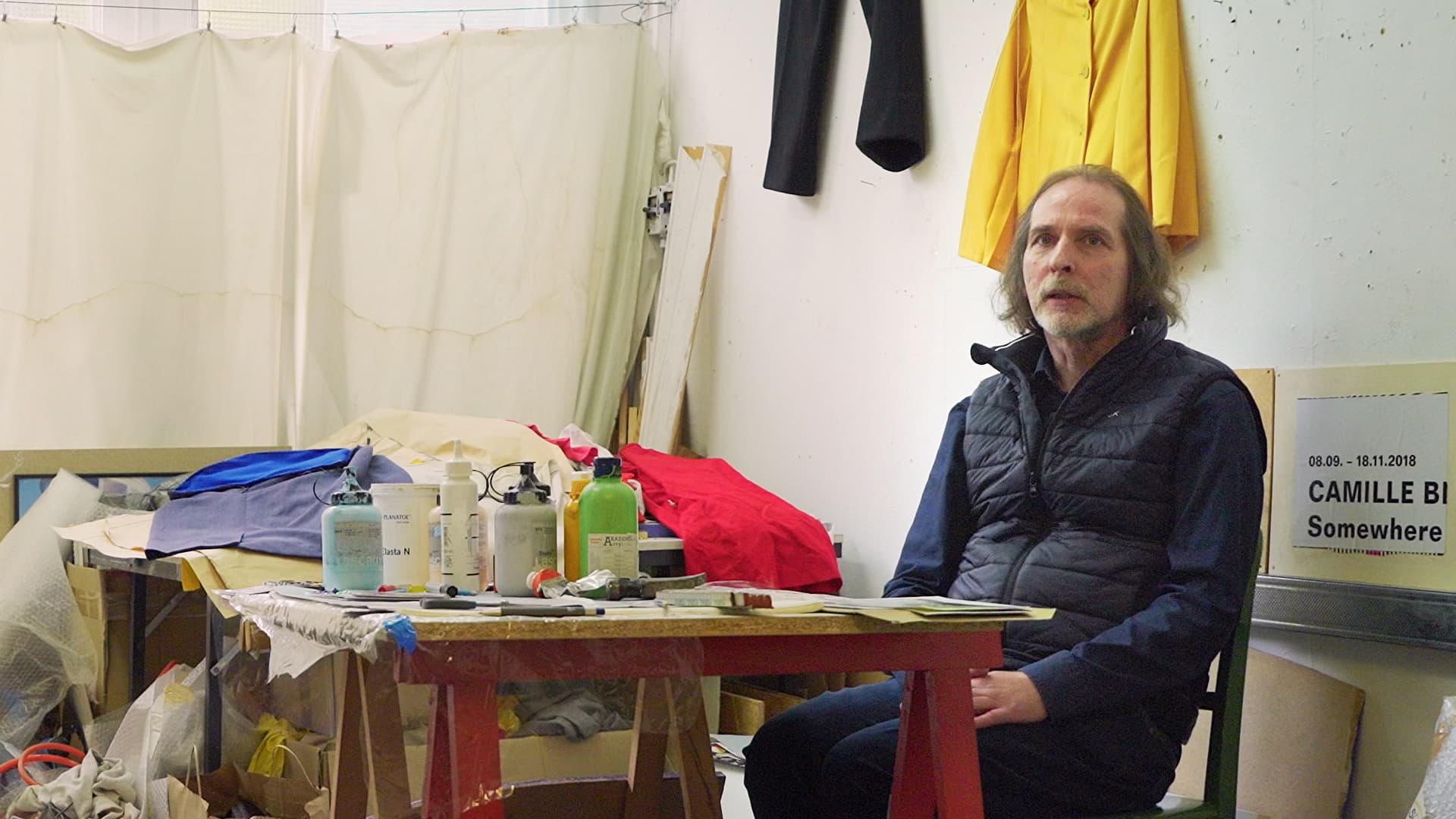
Andreas Exner
About the Artist
Frankfurt based artist Andreas Exner
also allows overlooked and disused everyday objects to influence his work, whether a discarded item of clothing or a car windshield. The Städelschule educated painter and sculptor creates his figures with a sense of humour and “paints” using textiles. Monochrome skirts and a denim jacket have been rendered unwearable due to the sewing shut of the relevant openings with similarly colored pieces of fabric.
In this way, they exist as painterly objects on the margins of painting. Their formal idiom is clear, but it is not ascetically modern: this is a real space, in which what al- ready exists can be seen differently. Historical art references are made, before being discarded. In 1970, Günter Fruhtrunk, the constructivist painter, created the design for the Aldi Nord plastic bag. This cheap everyday object was created with the intention of becoming a design object with a modern formal vocabulary, moving back onto the streets from the museum. Fruhtrunk was however criticized for this as, in the early 1970s, connecting art and commerce was regarded as suspi- cious and discount supermarkets were not yet wholly socially accepted. In a situation that resembled that which the Constructivists of the early twentieth century faced, the aesthetics of everyday life were once again at stake. Design is inherent to everyday objects, in their conception colors and format. In the mid-late twentieth century, the visually ubiquitous Aldi bag became a landscape image of Germany as well as a global export product. Founded in 1946, the company was ahead of the game regarding shaping one’s relationship to consumption in a world of ultracheap commodities, a world in which hand-made products no longer had a place. The Aldi Curtain [Aldi-Vorhang] (1999) transposes the plastic bag design back into a highly material form of painting. The curtain
is hung like a picture, playing with how we live in the world of commodities. The patchwork, sewn modestly by hand and machine, hangs like a banner on a shop window – a curtain for the stage of everyday life.