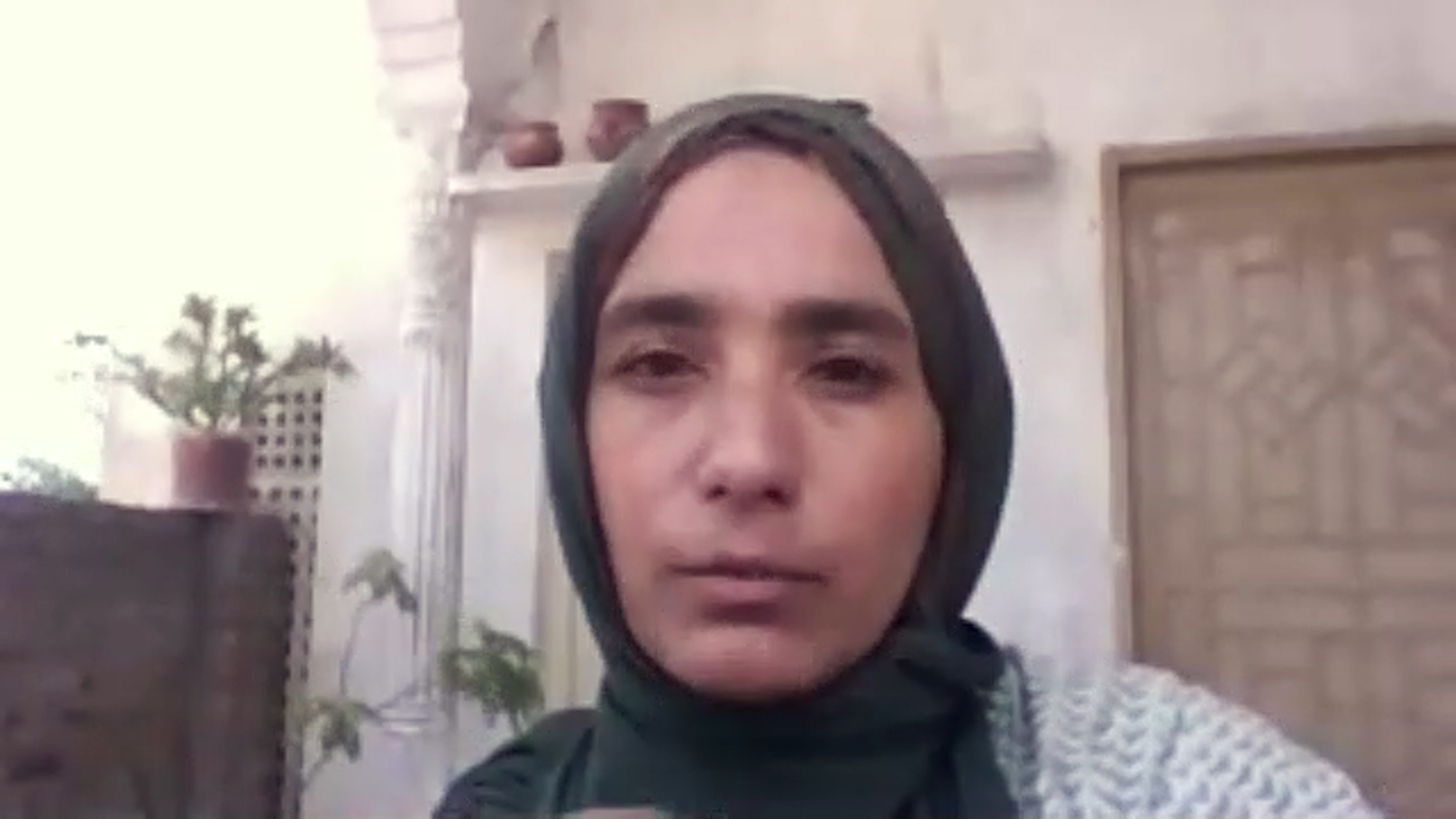
Zille Homma Hamid
About the Artist
The artist Zille Homma Hamid categorically does not view her objects in isolation. Her artistic practice engages with traditional, local craft techniques, and the context
in which these techniques exist. She learns from local craftsmen and women, expe- riencing what could only be the place’s poetry and absorbing the socio-political contexts in which these textiles are being produced. Referring to her German-Pakistani background, she finds visual signs, which can palpably embody transcultural and transhistorical relations, rendering them in textile form. The Blanket Coat [Couverture Manteaux] (2008), created in Dakar, is recognizable as a hybrid of coat and blanket. The woven blanket, with its abstract, rhythmic patterns, recalls the West African tradition of “Arkilla” blankets, which combines feeling with coded expe- rience and abstract patterns with cere- monial orders. Hamid has attached plain sleeves, the Blanket Coat is versatile:
it can be worn, it can be spread out and used to protect, and it enables prayer. Bearing the sign of religion, it has elegance in its form and movement.
In Dakar, she made a backstrap loom, an elementary yet highly flexible weaving frame, onto which cords are stretched between two wooden rods which are secured to a stable object and the body. The finished piece retains the relationship between loom and body. Hamid worked with this frame in Johannesburg, producing further selected works in South Africa in 2013: Dry White Season is reminiscent of miniatures by Sheila Hicks, who – like the Bauhaus’ female weavers – tried to understand materials and structures in terms of the intersection of threads.5 Textiles and text are linked through the craftsman’s technique and gesture. Regard- ing these two concepts, interdependent threads are woven into a single, coherent,mobile whole. Dry White Season is a care- ful transposition of politically active South African poet Mongane Wally Serote’s eponymous work into a woven figurative fabric, which, in turn, can be read as a poem. During the oppressive apartheid regime, poetry in particular gave access to suffering and resistance. In Fall Tomorrow (2013), the loose strings shine in a way akin to hair and are interlinked from both above and below. In many cultures, threads carry meaning – when written language isn’t dominant, they are a direct, creative form of communication. In Loom Chair (2013), Zille Homma Hamid made use of locally found materials – an old iron chair, stones from the side of the road, cords stretched out like threads and the strings of an instrument. Loom Chair quite liter- ally invokes the “chair” contained in the German word for “loom” – Webstuhl – a symbol of the bond linking human beings with the history of weaving. You can take this loom everywhere: as if it had been made for this very exhibition.