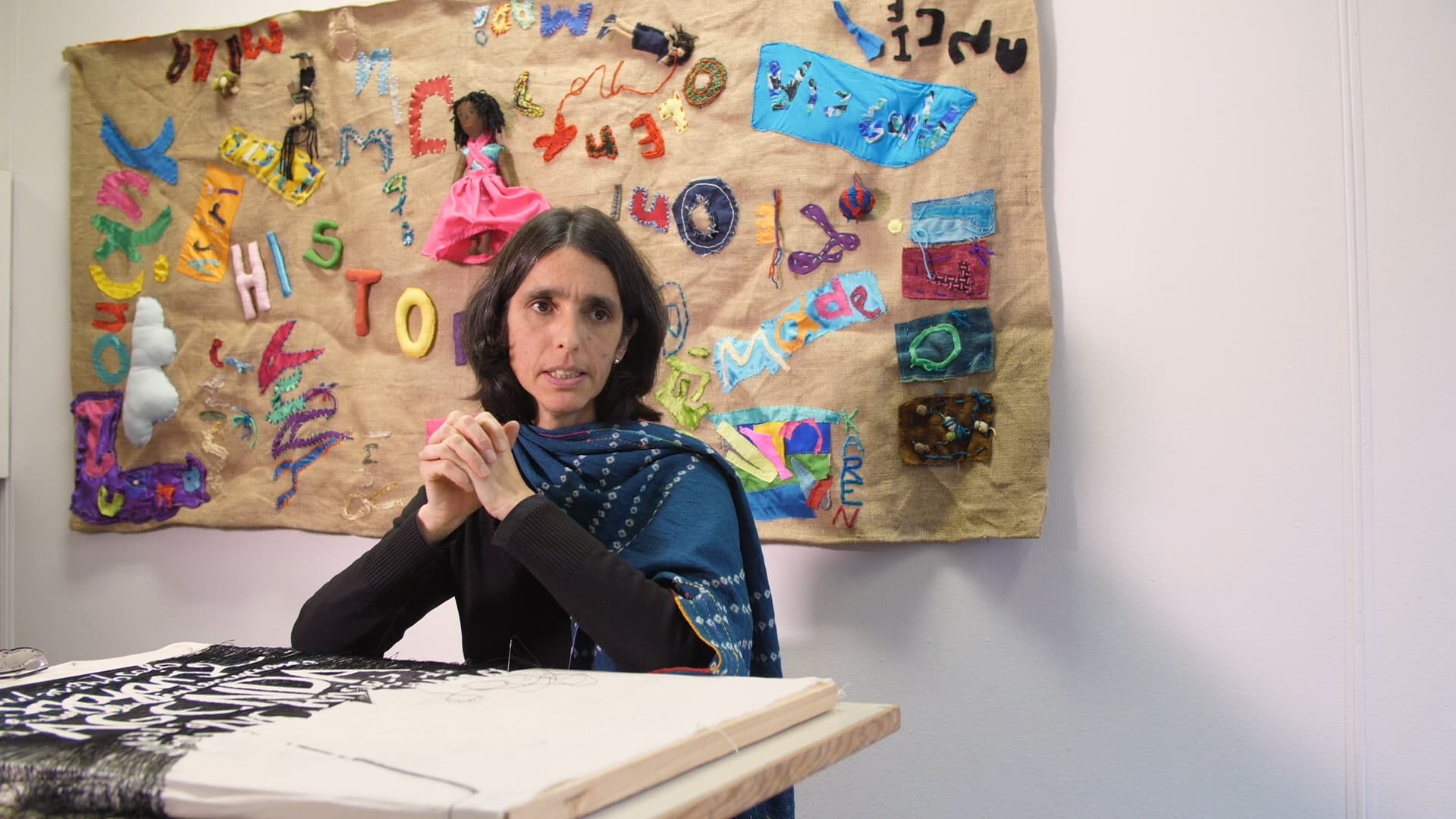
Karen Michelsen Castañón
About the Artist
“Between the memories of a quipu and those of a book, between the ramifications and geographies of home there lay many oceans. We need the embrace of a cord in order to knot them all together.” Textiles are connected with the nomadic character of people and things – we take them with us as a portable image on our journeys and when searching for a place of refuge. For Karen Michelsen Castañón, contradictory stories that are both individual and collective are bound together like a cord or a multi-layered cloth. She was born in Lima before moving to Vancouver to study textile arts, and later visual arts in Hamburg. Her video essay Embrace [Umarmung] (2001) addresses her and her family’s place within South American colonial history, and the ways in which that history is narrated. The film is a very personal approach
to her colonized identity. Her voice runs like a red thread throughout the film, a voice that is aware of the language of textiles. The ancient Peruvian quipus were a textile system within Andean culture used to store, classify and transmit information and memories. They were used for statistical purposes, as a historical narrative, and as a way of passing down songs and poems. On the one hand, quipus were a communications medium, granting the empire’s multilingual population access to certain information. Since the colonial era, western chroniclers had attempted to view quipus as a kind of standardized replacement for writing. However, modern researchers remain fascinated by the local diversity of the quipus, particularly how each material demands its own specific kinds of language and meaning depending on the location of its creation.