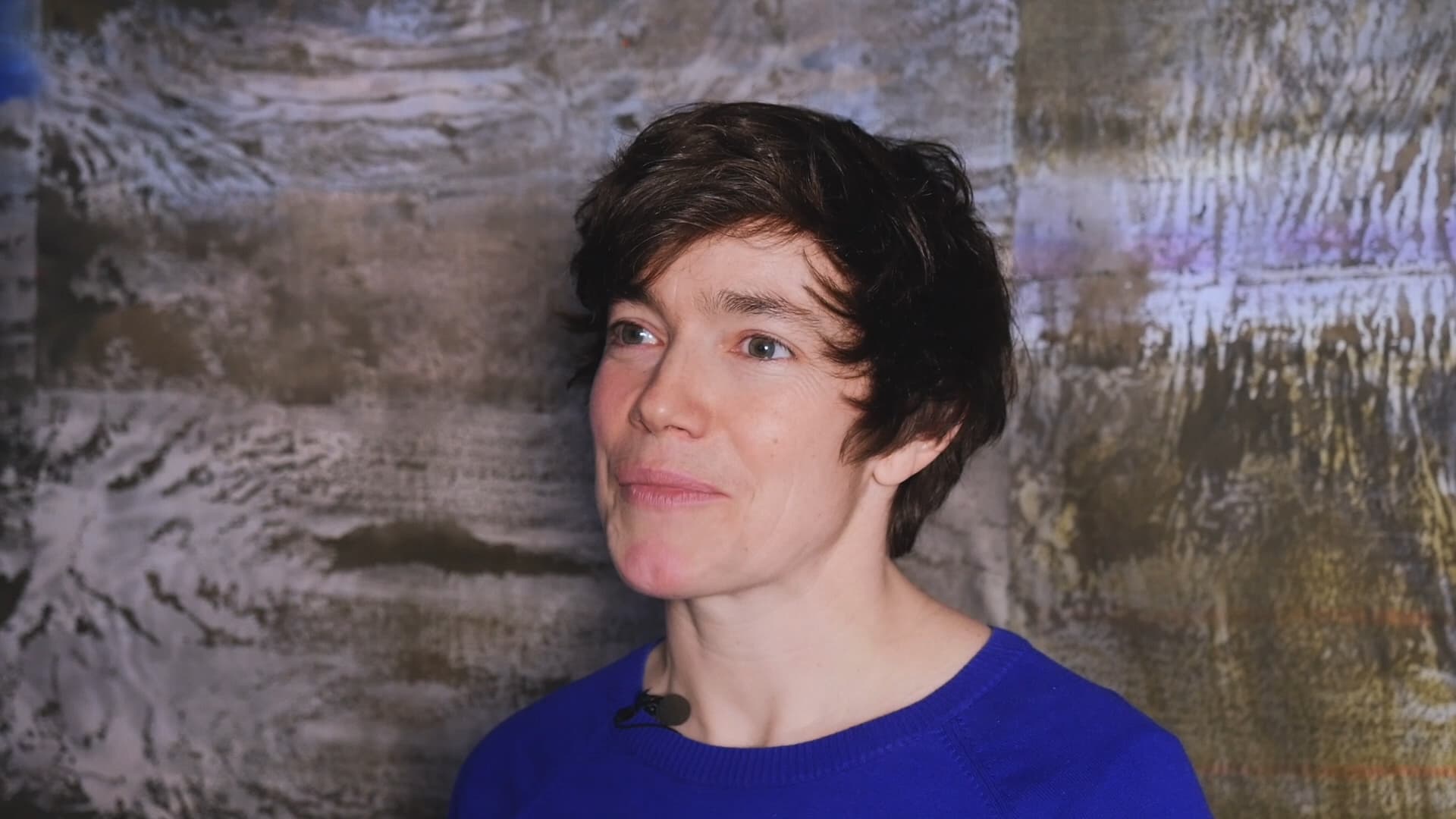
Judith Raum
About the Artist
The artist Judith Raum, also educated at the Städelschule, defines her painting practice as investigative and research-oriented. It is a practice that tries to find room for blind spots in our history. In doing so, Raum explores many paths simultaneously; one could say she does this primarily through the technique and materials with which she works. At the same time, her work investigates questions found in stories passed down in our society, the narratives of which are recorded and researched. In 2009, she chose the local textile production close to her hometown of Helmbrechts in the Upper Franconia region of Bavaria her starting point. Thus began an artistic research project spanning several years. It addressed the railway line to Baghdad built by Germany, and the associated economic connections between the German and Ottoman Empires. For Raum, this connection was embodied in the pattern books of her local textile museum, which documented fabric samples of home weavers from the nineteenth century. These domestic production sites, working with mechanical handlooms, were engaged in a global textile production in an extremely low-wage sector. As well as producing so-called “Turkish cloths” for export, these weavers also made ponchos and saris. Starting from this discovery, Raum prepared fabric panels, acting as a painter rather than a weaver. Her multifaceted paintings experiment with textile techniques: she colors in, takes away, and retraces her tracks with intensive pigments. What becomes visible is a retracing of work processes, but also a perception of flaws. An interpretation of the inexact, of what happens when the paint runs out and a new pattern suddenly emerges thanks to the transposition. Her video machine subjectivity (2012) shows various generations of weaving machines and asks what a non-instrumentalized relationship between subject and object would look like. Showing various handlooms in Germany and Turkey, the video illustrates how their use gave rise to forms of contact, resistance and improvisation.